


 Thai
Thai


01 The Short Version
A two-node cluster is only as good as the storage beneath it, and this is the part of a virtualisation refresh that is easiest to get wrong. Put direct-attached disks behind two Dell PowerEdge R770 servers and the redundancy is largely on paper: when a host fails, the data it was holding has to be restored before anything useful comes back. Put a Dell PowerVault ME5024 behind them across two independent 32Gb Fibre Channel fabrics and the failure model changes at the root, because the volumes were never owned by either server in the first place.
That distinction — ownership of data versus access to it — is what separates a cluster that survives a failure from one that merely survives a reboot.

02 The Defining Numbers
Four figures decide what this platform can absorb.
276 drives per system, reached through up to nine 2U or three 5U expansion enclosures. 1,024 snapshots per array, for test refreshes and recovery points. Eight 32Gb Fibre Channel or eight 25GbE iSCSI ports per array. Two hot-swappable, dual-active controllers with 16GB of cache each.
None of these is a peak-throughput number, and that is deliberate. Capacity, snapshot depth, port count and controller redundancy decide what the platform survives and how far a purchase can be deferred. Raw speed is a separate question, answered by the workload rather than by the specification sheet.
03 What It Replaces
Direct-attached storage has three failure modes, and they compound.
It binds every application to a single server. When that server fails, recovery means restoring data rather than restarting a workload — a difference measured in hours rather than minutes.
It fragments capacity. Each increase arrives as another isolated island with its own controllers, its own idle overhead and its own management surface, so the estate grows sideways instead of deeper.
And it makes test data expensive. Refreshing a development environment from production means copying data between systems, competing with live workloads for I/O at precisely the moment the business can least afford the contention.
Shared block storage answers all three at once: one pool that both hosts read from, one array to grow, and snapshots in place of full copies.
04 The Two-Tier Design
Both tiers are duplicated by design rather than by accident.
On the compute side, each R770 is dimensioned to run the full virtual machine set. The pair therefore operates active/active rather than main-and-spare: whichever node remains is already carrying the workload, and no capacity is reserved for a role it may never be asked to play.
On the storage side, the ME5024's controllers are dual-active and hot-swappable, and controller failover is transparent to the attached hosts. That transparency is the whole point. Without it, the compute cluster would be redundant against server failure while remaining hostage to a single storage processor — redundancy that reads well on a diagram and does nothing in a machine room at three in the morning.
05 Chassis and Physical Footprint
Both products occupy 2U. The R770 is a two-socket rack server; the ME5024 holds 24 × 2.5" drive bays in an all-in-one enclosure, with the controllers integrated rather than split across a separate controller shelf.
The practical result is a footprint argument. A refresh that retires a floor of standalone servers and their attached storage lands as two rack units of compute and two of shared capacity. That matters in a machine room running short of both rack space and power, which is usually how an estate that grew by addition ends up.
06 Interfaces and Connectivity
The R770 provides PCIe Gen5 expansion and OCP 3.0 networking, with 32Gb and 64Gb Fibre Channel host bus adapters available for the fabric connection.
The ME5024 accepts Fibre Channel, iSCSI (optical or BaseT) or SAS hosts. That flexibility carries a second-order benefit: the same array can serve a Fibre Channel fabric today and Ethernet-based hosts later, or be direct-attached where a workload suits it. The transport decision made now does not lock the platform in for its service life.
07 Management, Data Services and Automation
Configuration and monitoring run through PowerVault Manager's HTML5 interface, a command-line interface, OpenManage Enterprise integration and a Redfish / Swordfish REST API. The last of these matters most over time, because it turns repeatable provisioning into something scripted rather than something remembered.
Snapshot and volume copy services handle test-data refresh without a second production footprint. Asynchronous replication over Fibre Channel or iSCSI provides a recovery point on a second array, and because the ME5 series interoperates with the earlier ME4 generation, that second array does not have to be bought in the same generation as the first.
08 Specifications
Dell PowerEdge R770
| Specification | Detail |
|---|---|
| Form factor | 2U, 24 × 2.5" drive bays with integrated controllers |
| Controllers | two hot-swappable, dual-active; 16GB cache each |
| Host interfaces | Fibre Channel, iSCSI (optical or BaseT), SAS |
| Ports | up to 8 × 32Gb FC, 8 × 25GbE iSCSI or 8 × 12Gb SAS per array |
| Expansion | 12Gb SAS; up to 9 × 2U or 3 × 5U enclosures; 276 drives |
| Data services | RAID 1/5/6/10/ADAPT; thin provisioning; 1,024 snapshots |
| Encryption | AES-256 FDE with FIPS 140-2 Level 2 SEDs |
| Management | PowerVault Manager, CLI, OpenManage Enterprise, Redfish / Swordfish REST API |
09 What to Verify Before You Commit
Fabric design: confirm the two fabrics route independently, and verify multipath on both hosts rather than inferring it from the zoning.
Sizing: map the existing VM set against a single node, not against the pair. A cluster sized to the aggregate is a cluster that fails over into an overload.
Growth: decide in advance whether the first expansion is an enclosure or a second array. The two answer different questions.
Migration: agree maintenance windows, and test failover before cutover. Redundancy should be demonstrated, not asserted.
Snapshots: settle retention before the pool fills, not after.
10 Where This Fits
The value of this pairing is not that either product is remarkable in isolation. It is that together they remove the single points of failure a virtualisation estate accumulates as it grows by addition — and leave both compute and capacity free to expand without being rebuilt.
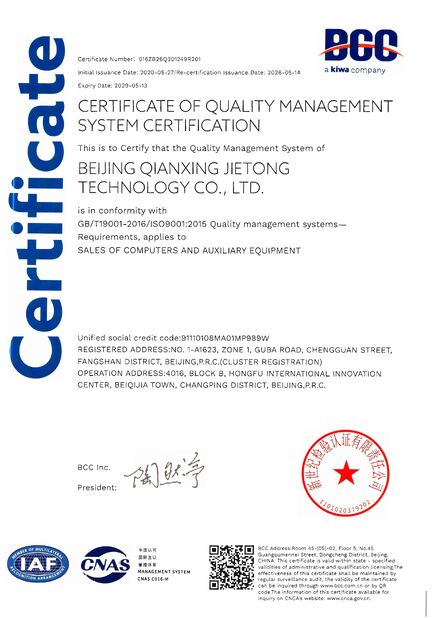
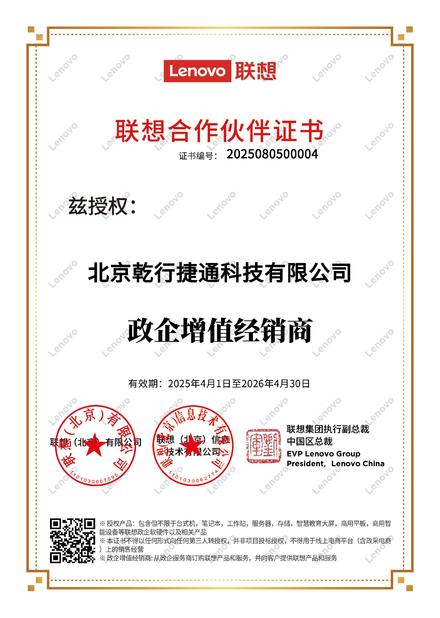
Beijing Qianxing Jietong Technology Co., Ltd.
Thinking Ahead, Meeting Needs, and Customer First.
Your Trusted ICT Product Service Provider!